Legislative Session Overview: 2026
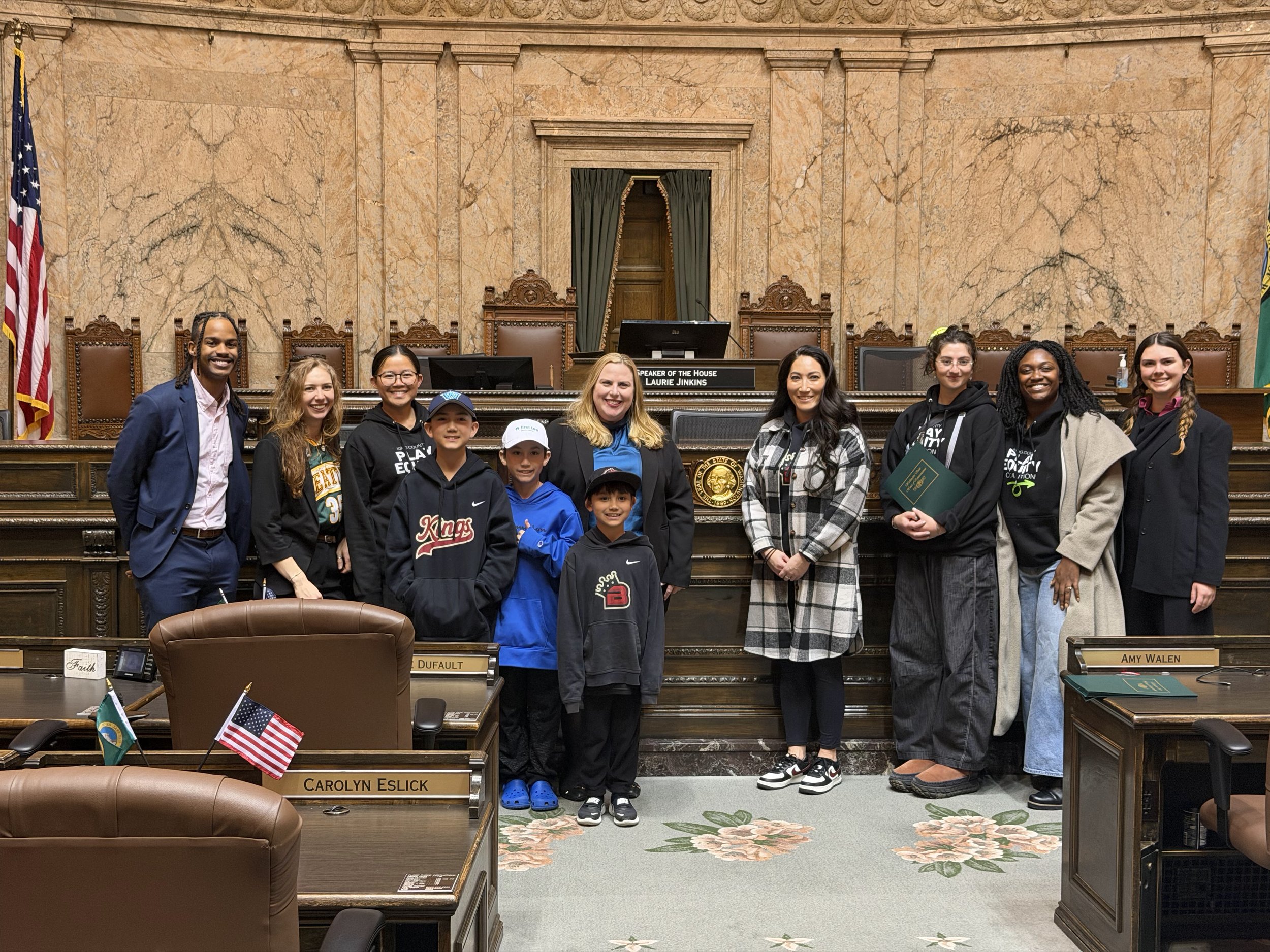
King County Play Equity Coalition's Youth Sports Day in Olympia
Session Dynamic
Washington’s 2026 legislative session officially concluded on Thursday, March 12th. Legislators were oscillating among priorities, with just 60 days to pass legislation and make significant decisions regarding the state’s budget amid the fiscal outlook. In the 2025 legislative session, lawmakers passed a $78 billion two-year budget for 2025-27, which generated $4.3 billion in new revenue through various streams and included $2.7 billion in service cuts. This year, the state had to pass a supplemental budget due to an anticipated shortfall in the 2025-27 budget. An underlying point of contention that lingered throughout the legislative session was the millionaire’s tax. The millionaire’s tax passed in both chambers of the legislature and imposes a 9.9% tax on the income of Washingtonians earning more than $1 million annually starting in 2028. This applies to household income, not individuals. For perspective, the tax will be paid by 0.5% of Washington’s wealthiest residents.
Washington’s tax system has long been considered imbalanced. According to the Institute on Taxation and Economic Policy (ITEP), Washington ranks 2nd for states with the most regressive tax codes. Meaning that lower-income households pay a larger share of their income in taxes than wealthier households. This legislation is a step towards creating a more equitable tax code in our state. Governor Bob Ferguson was reluctant to sign the legislation without additional revisions to reduce the tax burden on lower-income households and balance the tax code. Adhering to his request to see more breaks, the amended version of the millionaire’s tax exempts diapers and certain hygiene products from sales tax, repeals the select services tax enacted in 2025, increases the B&O tax credit for small businesses, and dedicates $150 million annually to city and county public defense services. The new tax is estimated to raise $3 billion annually.
Amid the fast-paced, action-packed session in Olympia, Pettigrew Consulting Services remained steadfast in our goal of executing our strategic plans with precision to achieve the best possible outcomes for our clients. We spent countless hours at the Capitol and beyond advocating for our clients, engaging stakeholders, and exemplifying the importance of our clients’ goals and initiatives. Building on the momentum of last year’s session, we built on our client success and set the stage for further success in the years to come. Take a dive into our client success report for the 2026 legislative session.
Client Success Overview
City of North Bend
This session, we spearheaded legislative advocacy for the City of North Bend on their Project 34 proposal. North Bend is situated on the crossroads of I-90 and Highway 18. This serves as a crucial passageway for connecting the agricultural and manufacturing hubs of eastern Washington to the ports of Seattle and Tacoma. Currently, the existing trucking stop is inadequate, resulting in long queues, unsafe conditions, sanitation issues, and crime. The site lies outside the Growth Management Area (GMA), creating a major barrier to development. The King County GMA expansion timeline was 2 to 4 years, which is too slow for the city's needs. This is where Pettigrew Consulting Services stepped in to pursue a legislative solution.
Multiple stakeholders had to be considered in the process of expediting the GMA expansion – the Washington State Department of Transportation (WSDOT), the Washington State Patrol, the WA National Guard, and Sound Transit. During the session, we convened with several legislators and state agencies and secured $200,000 in the transportation budget for a Project 34 feasibility study. The study will evaluate the preferred truck site and will be conducted in partnership with WSDOT and the Washington State Patrol. Findings will be presented to the legislature in 2027 and will guide future planning for project development and analysis.
Homestead Community Land Trust
Homestead Community Land Trust creates stability, equity, and opportunity by developing land and housing in trust, giving lower-income households the opportunity to own a home that is affordable to them and remains affordable to future owners. Homestead has enabled more than 300 households to achieve first-time homeownership, offering not just a set of keys but stability, dignity, and the security of predictable housing costs. Many of these homeowners are raising children, working essential jobs, and building lives deeply rooted in their communities, and through homeownership, they gain the freedom to plan for the future without the constant threat of eviction. The benefits are generational, with families experiencing greater financial resilience and children seeing improved educational, health, and economic outcomes. In a housing market where opportunities remain inequitable and even dual-income households are often priced out, Homestead is lowering barriers that have historically excluded many, resulting in more than 60% of its homeowners being led by BIPOC heads of household.
In this session, PCS advanced the priorities of Homestead Community Land Trust with a primary focus on affordable housing and policy to improve financial security, securing both legislative and budget wins. We were able to pass HB 2610 (companion bill: SB 6220), which clarifies property tax exemption for nonprofit housing providers and allows community-serving interim uses before construction. This means nonprofits will be able to offer classes, extracurriculars, and other activities during the predevelopment phase. This legislation will take effect on June 11th, 2026. Regarding the capital budget, we drove outcomes for Homestead by securing funding for its Skyway affordable housing project. The Skyway project is a 3-acre development that will include up to 57 affordable housing units – it is a community-led, anti-displacement initiative. Building on last year's success in securing nearly $9 million for the project, we achieved an additional $2.55 million this year.
Junior Achievement of Washington
Since 1953, the Junior Achievement of Washington (JAWA) has served over 2 million students across Washington State, equipping young people with life-changing skills in financial literacy, work and career readiness, and entrepreneurship. Its programs span elementary, middle, and high school levels, offering tailored learning experiences for each age group. In the 2023–24 year alone, JAWA reached 47,132 students through 1,137 classes across 341 schools, supported by 2,695 local volunteers. As a trusted pillar in the community, JAWA is dedicated to inspiring and preparing young people, particularly those in underserved communities, to succeed.
This year, PCS was able to secure $258,000 in capital budget dollars for repairs to JAWA’s South Seattle facility. Key facility upgrades will focus on energy efficiency, including installing a high-efficiency HVAC system and advanced smart energy management solutions to significantly reduce energy consumption. These improvements are designed to lower operating costs while supporting long-term sustainability goals.
Northwest Kidney Centers
Northwest Kidney Centers is a nonprofit healthcare organization based in Seattle that provides care for people with kidney disease – especially those who need dialysis. Their core services are dialysis care, chronic kidney disease management, patient education and nutrition support, and transplant coordination and support. Furthermore, the organization offers kidney disease education to inform and spread awareness. In this session, PCS successfully championed $157,000 in capital budget dollars for dialysis chair replacement, which is critical for long treatments. This will provide patients with a more pleasant experience while they receive the care they need.
YMCA of Greater Seattle
The Greater YMCA of Seattle is a large nonprofit focused on youth development, healthy living, and social impact across the Seattle region. At the core of the mission, they aim to strengthen communities, support youth, promote health and well-being, and ensure access regardless of income. Encouraging youth to engage in the outdoors, the YMCA offers camps and outdoor leadership programs. The program combines the development of core life skills through a modern curriculum, exploration, and teambuilding. In this session, PCS secured $206,000 in capital budget dollars for the YMCA’s Camp Coleman. The camp is located an hour outside of Seattle, on the Key Peninsula, and sits in the foothills of the Olympic Mountains. The property is over 100 acres and includes a half mile of Puget Sound beachfront and stellar views of the Cascade Mountains. The camp has been active for over 100 years – serving youth and providing them with invaluable experiences that will translate into valuable life skills.
Making A Difference Foundation
Making a Difference Foundation (MADF) is a nonprofit, charitable organization with the mission of making a difference in the lives of others, one person at a time, by helping them meet their most basic needs: food, housing, encouragement, and opportunity. Making a Difference Foundation offers comprehensive hunger relief services and social programs to support underserved communities. This session, PCS helped secure a key legislative victory for MADF through the passage of HB 2238 – the Statewide Food Access Bill. This bill creates a strategy to address hunger and food access in Washington. The law tasks the Washington State Department of Agriculture (WSDA) with developing a comprehensive plan that emphasizes food access, agricultural viability, and supply chain resilience. The WSDA will be required to work with state agencies, tribes, nonprofits, universities, agriculture, and other key stakeholders as it develops its strategic plan framework. The WSDA will be responsible for tracking metrics relating to hunger rates, cost barriers, and supply chain issues. The long-term goal of this legislation is to eradicate hunger in Washington State, reduce health inequities linked to food access, and strengthen the state’s overall food system.
Session Summary
Budget Wins:
City of North Bend: $200,000 Secured (Transportation Budget)
Homestead Community Land Trust: $2,550,000 Secured (Capital Budget)
Junior Achievement of Washington: $258,000 Secured (Capital Budget)
Northwest Kidney Center: $157,000 Secured (Capital Budget)
YMCA of Greater Seattle: $206,000 Secured (Capital Budget)
Policy Wins:
HB 2160: Ensuring nonprofit housing providers qualify for a property tax exemption when the property is temporarily used for certain community purposes other than affordable housing.
HB 2238: Statewide Food Access Bill – concerning statewide food security.
As we revel in the success after months of hard work, we remain committed to the work ahead. During the interim, we are shifting our focus to strategic planning for the 2027 legislative session. Our diligent preparation will allow us to build on the foundations we've set through our victories!
Written By: Brad Blackburn III